
Home / Church Livestreaming / Start Here
Start Here · Lesson 1 of 4
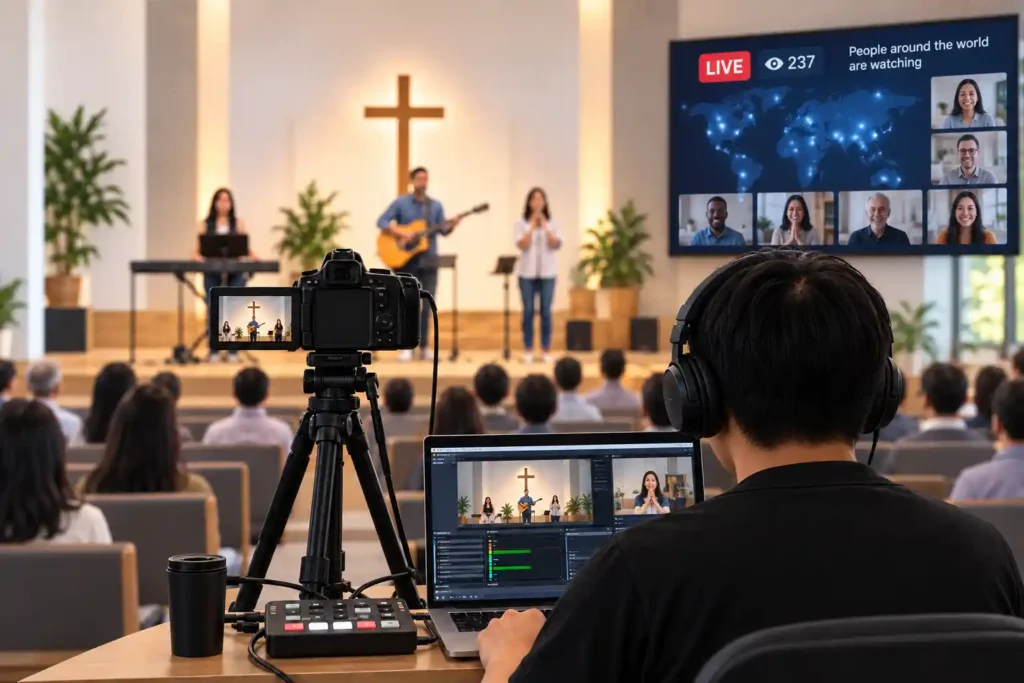
Before a church chooses cameras, software, or a budget, it is worth pausing on one question: who does this actually serve? The answer is not as obvious as it might first sound, and it shapes almost every decision that follows — what gets purchased, how much time goes into the livestream, and what counts as good enough. This article does not yet deal with technology or cost. It deals with the reason that guides both.
Who the Livestream Actually Serves
“Reach” is an easy word to say, but on its own it doesn’t say anything. Naming the actual people turns the reason into something practical.
The livestream serves at least four groups: someone who is sick or recovering and cannot attend in person; someone who is traveling — away from their home area that particular Sunday for work, study, or family reasons; someone who has moved farther away but wants to stay connected to a familiar church; and someone who has only just become interested in the church but is not yet ready to attend in person.
Naming these groups matters more than it might seem. Once you know who you are serving, you also know what the viewing experience needs to provide — not spectacle, but the ability to actually take part in the teaching and the worship, to see and hear well enough.
Consider a church member who is recovering from surgery at home and cannot attend. On Sunday morning they open the livestream and follow the same teaching and the same worship that the rest of the congregation experiences in the room. They are not present in the space, but they are present in the moment.
Another example is someone who has heard about the church but does not yet feel ready to attend in person. They watch the livestream first from home and get to know how the service comes together. Only afterward do they decide to come and visit in person.
The Livestream Complements Gathering — It Does Not Replace It
The point of these examples is not to downplay being physically present. Gathering together in person — meeting others, singing together in the same room, talking after the service — is something a screen never fully replaces. The livestream does not compete with this. It complements it in situations where being there in person is not possible.
This distinction is worth keeping in mind throughout the whole course. The livestream is not built so that people stay home. It is built so that those who otherwise could not take part at all get to take part in some way.
Why This Question Comes First
The reason for livestreaming is not just background information — it is the standard against which later decisions are measured. If a church has not clearly thought through who it serves, it becomes hard to judge whether the next step should be a second camera, better audio, or on-screen song lyrics. Every one of these decisions affects how well the people you have just named are able to take part.
Once the reason is clear, setting limits also becomes easier. There is no need to aim for every possible feature right from the start — it is enough to aim for whatever best serves the people who are actually watching the livestream.
What a "Good Reason" Means in Practice
A good reason is concrete, not abstract. It is not “we want to be visible online” but “we want someone who has to stay home because of illness to be able to follow the teaching just as well as someone sitting in the room.” This distinction shows up throughout the course: whenever a later question comes up — what a “good livestream” means, or whether a second camera is worth getting — the answer always comes back to this same question: does this choice serve the people the livestream exists for.
Two Paths Forward
After this article and a few other shared articles, the course splits into two paths. One is for the person who makes decisions — the church leadership responsible for budget, schedule, and team. The other is for the person who does the hands-on work — the volunteer working with the camera, the audio, or the streaming software.
Neither path needs to be chosen right away, and many readers will need both — for example, a media team leader often both makes decisions and does hands-on work. It is worth reading the shared articles in full before moving on to either path, because they build the shared understanding of what a “good livestream” means — and the reason discussed in this article is the foundation everything else is built on.
What to Remember
- The livestream serves specific people: those who are sick or recovering, traveling, living farther away, or newly interested — not an abstract idea of “reach.”
- The livestream complements local gathering; it does not replace it.
- A clear reason guides later decisions about budget, expansion, and quality throughout the course.
- A good reason is always concrete: it names who a choice serves, not just that “visibility increases.”
- The course continues on two paths, for the decision-maker and for the operator — many readers will eventually need both.