
Home / Church Livestreaming / Operator Path
Operator Path · Lesson 7 of 15
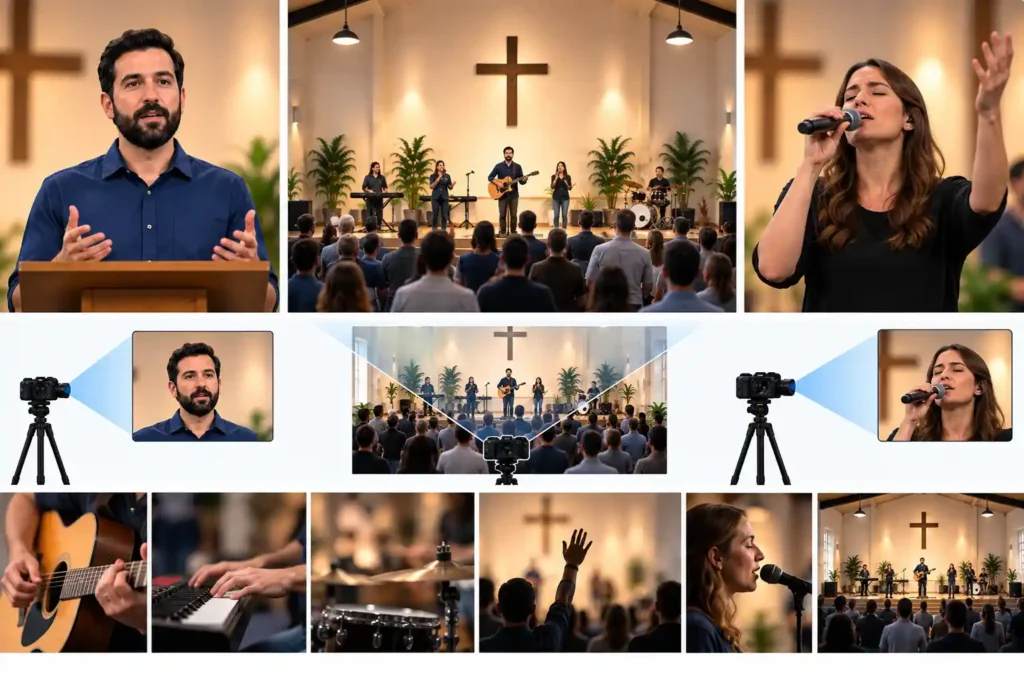
The cameras are positioned, and the optics are chosen — but picture quality isn’t decided by equipment alone. It’s decided by how the camera is used during the stream. Speech and worship music are two parts of the same service, but they work visually in different ways: the same editing rhythm doesn’t serve both equally well. This article looks at why it’s worth making that distinction deliberately, and what it looks like in practice.
Filming speech: stillness is intentional, not laziness
When someone is speaking, the viewer’s attention needs to stay on the message, not on the picture. For this reason, a steady medium shot is worth using during a speech segment — a framing that shows the speaker from the waist up, so that the face and eye contact are clearly visible — and cuts should be rare. This course’s recommendation is to cut during speech only when the speaker takes a natural pause: a change of thought, a move to another point, or the end of a paragraph in the text. In practice, this means the picture stays in place considerably longer than during worship — a single shot can easily last through several ideas or paragraphs of text.
The reason is simple: every cut is a small interruption. A few interruptions a minute don’t bother anyone, but frequent cutting starts drawing the viewer’s attention to the picture itself rather than the message. A micro-example illustrates this: if the operator switches the picture during a speech every twenty seconds without a clear reason, the viewer starts, without noticing it, to anticipate the next cut instead of listening to the speech. A calm picture isn’t a boring choice — it’s a choice that gives the message room.
Filming worship: liveliness supports the experience
Worship music is a different situation. There’s movement, rhythm, and shifts in mood in the music, and the picture is allowed to follow it. In this segment, more camera angles and more frequent cuts are justified — not because there should be a lot of variety, but because the music itself offers natural break points. A verse turning into a chorus, a solo, a change of tempo, or a structural turning point in the song are typical moments where a cut feels justified rather than distracting. As a general direction, this means clearly more frequent cutting than during speech — the picture most often changes once within a verse, chorus, or other musical section, not just when the section changes — but still deliberate, not mechanical switching.
The other direction matters just as much: a completely static, unchanging picture for the entire worship segment often feels boring to the viewer, even if the picture itself is technically flawless. Micro-example: if the worship team plays and sings for twenty minutes in one and the same wide shot with not a single change, a viewer following online starts to experience the stream as distant — like watching security-camera footage rather than an event. A little deliberate movement and variation helps the viewer feel part of the moment, rather than only outside it.
Camera 2's role in both situations
The second camera, which usually shows a wide shot of the whole stage, is useful in both speech and worship — but in different ways. During speech, the wide shot can be used sparingly, for example when the speaker moves across a clearly wider area or makes a large gesture, before returning to the medium shot. In worship, the same wide shot works differently: it brings scale and energy, alternating with tighter shots at the music’s turning points. Which camera’s technical choice or placement this involves isn’t the subject of this article — what matters here is that the same shot option serves two very different situations at different rhythms.
The difference is intentional, not accidental
The different way of filming speech and worship isn’t an arbitrary rule — it follows from what each moment asks of the viewer. Teaching asks for focus and stillness; worship asks for presence and movement. When the picture adapts to that difference, it supports what’s already happening in the church itself — someone joining online experiences the same shift in atmosphere as someone present in the room. This doesn’t require complicated equipment, just a deliberate decision about when to cut and why.
It’s also worth remembering that neither extreme is a goal in itself. Cutting too often during speech is tiring, but cutting too often during worship can also turn into restlessness if the changes don’t follow the music’s natural structure. The goal isn’t to cut a lot or a little, but to cut when the content itself gives a reason to.
What to Remember
- During speech, a steady medium shot and rare cuts support focus on the message — cut only at a natural pause, not mid-thought.
- During worship, more camera angles and more frequent cuts are justified when they follow the music’s turning points.
- A completely static picture for the whole worship segment often feels distant to the viewer, even if the picture itself is technically good.
- The wide shot (camera 2) serves both speech and worship, but at different frequency and for different purposes.
- The amount of cutting isn’t a value in itself — what matters is whether the cutting follows the content’s own rhythm.