
Home / Church Livestreaming / Operator Path
Operator Path · Lesson 15 of 15
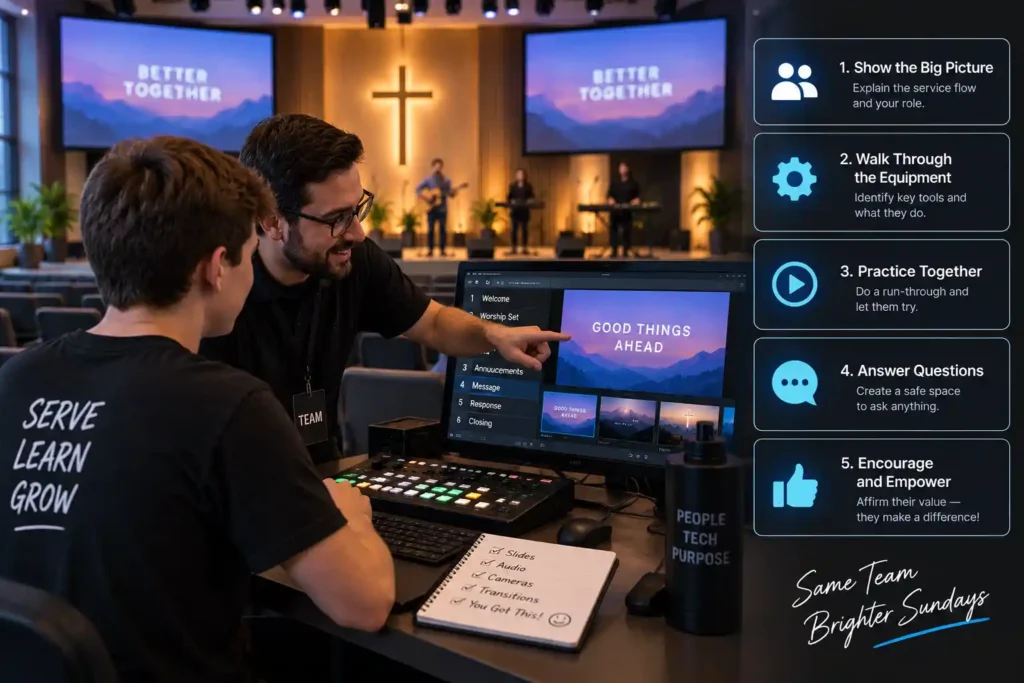
Sooner or later, a new volunteer needs to be taught to run the broadcast. The most common approach works poorly whenever something deviates from what’s expected, even though it feels like a natural starting point: a new person stands next to the more experienced operator for a few Sundays, watches what happens, and then one Sunday is left alone. This article is written for whoever is responsible for training — an experienced operator or a media team leader — and describes a path that actually produces a genuinely capable second person, not just a familiar face next to the equipment.
Start with concepts, not buttons
The fastest way to train someone is to show a sequence of button presses: press here, select this scene, check this meter. That works, as long as nothing goes differently than in practice. As soon as something deviates — a camera angle has shifted slightly, the audio sounds different, a familiar notification appears in the wrong place on screen — a memorized sequence alone isn’t enough anymore, because the new volunteer doesn’t know what the solution actually does.
For this reason, training is worth starting with concepts: why the picture is taken from this particular source, why audio is taken from the mixer’s aux output rather than the room’s main output, why scenes are deliberately kept few. Once a new volunteer understands the principle, they also know what to do when the situation departs from what was rehearsed. Only after that is the concrete sequence of actions taught — it’s learned faster once the logic behind it is already familiar.
Consider a situation where a new operator has been taught the exact sequence of button presses, but was never told why audio is taken from that particular source. When a small change is made to the mixer and the audio path shifts by one channel, the operator can’t work out where the new source is — they only know where it has always been.
Practicing without a real broadcast
The first time at the controls must not be a Sunday when a real broadcast is running. This calls for a separate practice session, where the whole routine is run through from start to finish — startup, checking picture and audio, a few minutes of “broadcasting” that goes to no one — without anyone feeling pressure to get it perfectly right. A session like this is worth repeating regularly, for example once a month, even when there’s no new person being trained: it keeps even more experienced people’s skills sharp and makes practicing a habit, not an exception.
During practice, it’s worth letting the new volunteer do everything themselves, with the mentor sitting alongside without stepping in unless something is genuinely going wrong. Simply watching from the side doesn’t build the same confidence as doing it yourself, even though it might feel like a more efficient use of time.
Practicing mistakes on purpose
The real difference comes down to whether the volunteer is also taught what to do when something goes wrong. During a practice session, this means the mentor deliberately causes a failure — for example, disconnecting a camera cable for a moment, muting the audio on the mixer, or switching OBS to the wrong scene mid-exercise. The new volunteer then works through the situation using the same logic as in a real broadcast — often with the help of the very instructions written down for the most common failure situations.
This isn’t meant unkindly, and it isn’t meant to confuse anyone. The point is that the first time a cable comes loose or audio disappears isn’t a Sunday when a viewer is already on the other side of the screen. A rehearsed response is considerably calmer than an unfamiliar surprise encountered for the first time.
Consider a hypothetical practice session where a mentor unobtrusively disconnects a camera cable for a moment during a “broadcast” exercise. The new volunteer notices the black screen, checks the cable first and then OBS’s source, and gets the picture back in under a minute — exactly as they had just been trained to do. If a similar situation happens for real later on, the rehearsed calm carries directly into practice.
When a new volunteer is ready to run the broadcast alone
There’s no exact number of practice sessions that guarantees readiness — but three things are worth seeing before a volunteer is left alone with a real broadcast. They have run the whole routine themselves, start to finish, without the mentor needing to take over the controls. They have faced at least one rehearsed, deliberately caused failure and come through it calmly. And they use the written checklist on their own initiative, not only when someone reminds them to.
Once these three are in place, the next natural step is to let the volunteer run a real broadcast with the mentor still present, but staying in the background without stepping in. Only after this, too, has gone well is the volunteer truly ready to run a broadcast entirely alone.
Two trained people, in practice
Having two people “trained” only means something in practice if both of them have actually run the broadcast from start to finish, not just sat beside it. As noted in the Leader Path article on key-person risk, responsibility is worth rotating regularly between two trained people. In practical terms, this adds one concrete thing: keep a record of when each person last ran the broadcast themselves — not from memory, but written down, for example in the same place as the rest of the practical documentation. Without this record, the rotation is easily forgotten, even if everyone agreed on the principle.
Written material is the backbone of training
The startup-and-shutdown checklist and the guide to common failure situations aren’t just an experienced operator’s notes — they’re the most important tool in training. During a practice session, they’re used actively: the new volunteer works through the checklist out loud, and when a failure occurs, they reach for the instructions instead of guessing. This teaches a habit that carries on after training is over too: when something deviates from normal, the first step is always the written instructions, not a guess from memory.
What to Remember
- Training starts with why the system works the way it does, not directly with the sequence of button presses — understanding the concepts also carries through when a situation deviates from what was rehearsed.
- The first time at the controls belongs in a practice session, not a real broadcast; regular practice, for example monthly, keeps the skill sharp even for more experienced people.
- Failures are worth causing deliberately during practice, so the first encounter with a real disruption doesn’t happen during an actual broadcast.
- A volunteer is ready to run the broadcast alone once they have run the whole routine themselves, come through a rehearsed failure calmly, and use the written instructions on their own initiative.
- Two trained people only becomes a practice once responsibility genuinely rotates regularly between them, not just in principle.
Next: this was the last article in the Operator Path — revisit the Leader Path if needed (Avoiding Dependence on One Key Person and Leading the Media Team as Service) to close the loop.