
Home / Church Livestreaming / Leader Path
Leader Path · Lesson 5 of 6
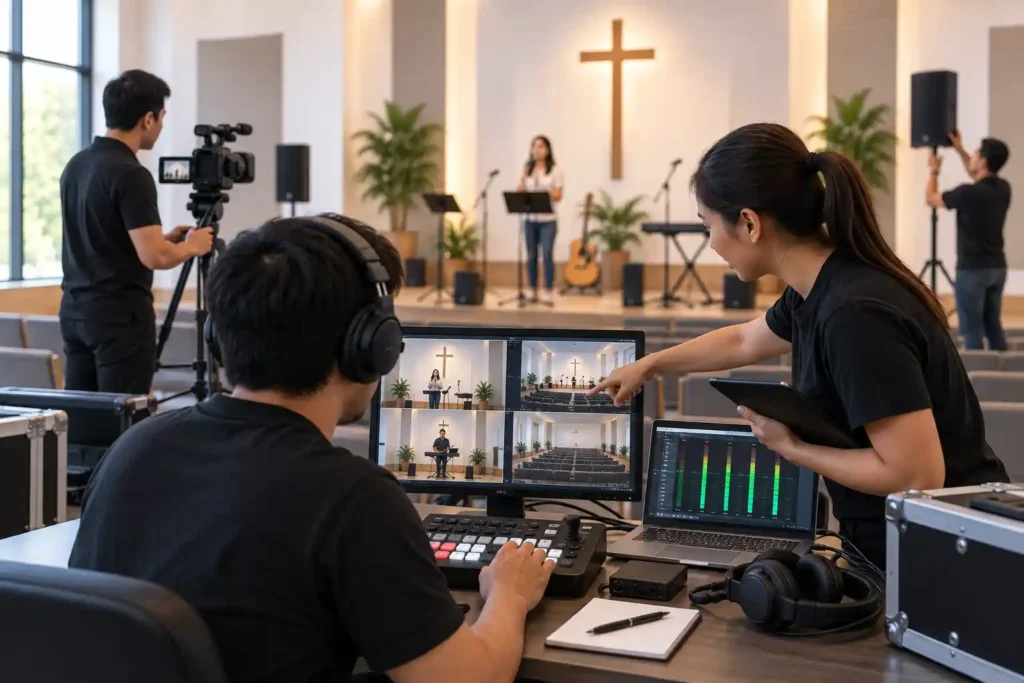
When a church plans livestreaming, thinking easily jumps straight to people: who handles the camera, who handles the audio, who makes the graphics. It is worth starting the other way around — from roles, not names. Roles show what tasks the system requires; only after that does it make sense to consider how many people actually handle them. In a small church, the answer often comes as a surprise: far fewer than the number of roles would suggest.
Four roles, not four people
The media team’s work divides conceptually into four roles: operator, camera, audio, and graphics. The operator holds the whole broadcast together — starting the system, watching the preview, and making the necessary switches. The camera role is responsible for the picture being correctly sized and stable. The audio role ensures the stream audio is understandable, not just an echo of the room. The graphics role prepares the text and images shown in the broadcast.
These should not be thought of as four positions requiring four different people to be recruited. They are four areas of responsibility that can all live within one person’s skill set — and in a small church, that is usually exactly how it works.
One operator goes a long way
In this course’s first system, all four roles merge into a single task: the operator starts the system, the camera is already mounted in the correct framing, and the audio comes from the mixer’s line output without anyone adjusting it live. This does not change as soon as a second camera is added. The two-camera base system is designed so that one trained operator runs it alone — the shots are pre-built, so the decision made live is only “switch or not,” not building the picture mid-broadcast.
Consider a church that has just introduced a second camera. On Sunday, one operator is present, watching two preview pictures and switching between them according to shots that have already been framed. The camera role does not need its own person, because it merged into the operator’s work back at the installation stage.
This does not mean one person carries the whole responsibility alone. At least two people are trained to use the system from the start, but they do not need to be present at the same time. The combination of two trained people and one running the broadcast is this course’s starting point, not a temporary arrangement before a “real” team.
How roles separate out as the system grows
Roles start to separate from each other in two different ways as the system grows — not because one operator becomes insufficient, but because part of the work moves away from Sunday itself.
The clearest example is graphics. Once song lyrics and simple graphics are introduced, their text is always prepared in advance, never live. This means the graphics role can move entirely to another volunteer who is never present on Sunday morning. One church member can prepare the week’s song lyrics from home and send the file to the operator before the broadcast. This also opens up the media team to volunteers whose schedule does not allow a Sunday morning commitment.
The audio role separates more slowly and in a different way. Once room microphones and more precise audio control are introduced, the task requires basic EQ and gain skills, and tuning across several broadcasts — something the operator can learn as an additional skill, not necessarily a reason to recruit a new person. Only at the stage of a third camera or clearly more advanced production does the recommendation for a second, simultaneously present operator start to become justified, because tracking more sources and possibly a control panel at the same time increases the load. Even before that stage, the model stays the same: one running, two or more trained in the background.
What skill a role actually requires
When looking for a volunteer for the media team, it is easy to think a technical background is needed. In practice, calmness and attentiveness matter more: the ability to follow the same routine every week in exactly the same way, and to stay calm if something does not work as expected right away. Consider a volunteer who has never used production software before, but who always performs the same check in the same way before every broadcast. After a few months of training, they may become the team’s most reliable operator — not because they learned the most technology, but because they never skip a step.
Rotating roles keeps the team alive
Once more than one person is trained in the same role, it is worth rotating it — not just so the backup person stays current, but because one person’s continuous responsibility for the same task every week wears them down, even if the task itself is light. The same applies to moving between roles: a volunteer who has learned the operator’s tasks can later also learn the basics of the audio or graphics role. This is not mandatory, but it makes the team more flexible and gives an individual volunteer room to grow in their role without having to switch entirely to a different area of service to stay engaged.
How this workload is managed in practice is the subject of the next article.
What to Remember
- The media team’s work divides into four roles — operator, camera, audio, graphics — but these are areas of responsibility, not positions: in a small church, one person carries several roles at once.
- The first system and the two-camera base system are designed to be run by one trained operator; at least two trained people are needed for continuity, but not two present at the same time.
- Roles separate as the system grows in two ways: some work, such as graphics preparation, can move entirely away from Sunday, and only in clearly more advanced production does a second, simultaneous operator start to become justified.
- The most important quality in a volunteer is not a technical background but calmness and attentiveness in a repeated task.
- Rotating roles and responsibilities keeps skills shared and prevents any one volunteer from becoming overloaded.