
Home / Church Livestreaming / Leader Path
Leader Path · Lesson 2 of 6
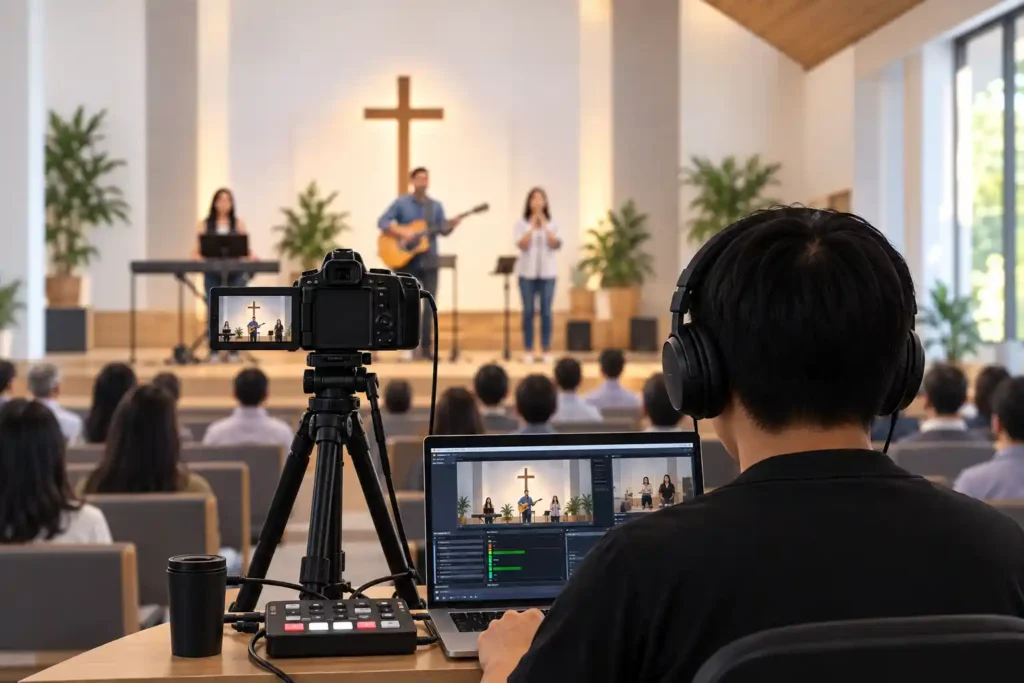
When a church decides to build a livestreaming system, the first instinct is often to acquire enough cameras right away so the broadcast looks finished. That instinct is understandable, but it often leads to the wrong decisions. One well-chosen, well-positioned camera is not a temporary solution waiting to be replaced as soon as possible — it is a complete, working system that can serve a church for years. This article explains why that is a deliberate choice, not a compromise, and how to make that case to others in the church.
Why "simple" does not mean "lacking"
It is easy to think of one camera as a temporary stage meant to grow into several as quickly as possible. This thinking confuses two different things: what the system is capable of, and what the viewer actually needs. A viewer following the worship service from home does not judge the broadcast by the number of cameras. They judge it by whether they can clearly see and hear the speaker and feel part of the moment. One camera that reliably fulfills this task every week is a successful system — not a basic version of something better.
What one well-implemented camera delivers
The task of a one-camera system is simple to state: produce a stable picture in which the speaker appears at the right size. In practice, this means the camera is positioned and framed so the viewer sees the face and expressions, not a distant figure on a stage. When this is achieved, the viewer can engage with the message in much the same way as someone sitting in the room would see and hear it. The framing and positioning of the shot are worked out carefully once, during installation — not decided again every Sunday. Once this work has been done properly, the operator no longer needs to make decisions about the picture during the broadcast, and can instead focus on making sure everything is running.
Reliability is won through simplicity
The fewer moving parts a system has, the fewer points there are where something can go wrong. A one-camera system has no camera switching and no multiple sources to track, and the operator never has to decide which picture to use at any given moment. The operator’s task during the broadcast is light, which means that almost any trained volunteer can run the broadcast from start to finish without needing to be the specific person who built the system. This connects directly to how independent a church is from a single key person — a topic covered in more depth later in this path.
Consider a church that runs the same one-camera system year after year. The operator may change several times along the way, but the broadcast continues without interruption every week, because a new operator can always learn the system in a few practice sessions.
A lasting foundation, not a temporary step
When a first system is designed with the thought “this will be replaced soon,” it is easy to make compromises that do not hold up under use: a weak mount, a carelessly considered angle, cabling meant to be “fixed later.” When a first system is instead designed with the thought “this needs to last for years,” the same decisions are made more carefully from the start, and the result serves the church for a long time without anything needing to be dismantled and rebuilt. Later expansions — a second camera, room microphones, lyrics on screen — build on this same foundation; they do not replace it.
Why too many moving parts at the start is a risk
It can feel tempting for a church to acquire several cameras and a switching device right away, if the budget allows. However, every added part also brings more decisions, more need for training, and more ways something can fail right when no one is ready for it.
Consider a church that acquires three cameras and a switching device right from the start, because the money is available. On the first broadcast Sunday, the team tries to learn camera positioning, switching, and a new audio mixer all at the same time, and no one has time to focus properly on any single part. The picture switches at the wrong moment, one camera goes completely unused, and the broadcast proceeds unevenly from start to finish.
The same money and time could instead have produced one excellently functioning camera and a system that more people would have learned from the very beginning. Complexity is not progress in itself — it is only progress once a church already has an established foundation and the readiness to carry the responsibility that comes with it.
When one camera starts to feel insufficient
A one-camera system is not a permanent solution for every church, nor does it need to be. The need for a second camera usually arises only once the first stage has been in use for a long time and has proven reliable, and once the church notices it wants more variation in its visual storytelling — for example, a different angle during worship music, or a backup shot in case of a technical failure. This is a good sign that the first stage has done its job, not a sign that it was insufficient from the start. When that moment arrives, and what it actually requires, is covered in the next article.
What to Remember
- One well-chosen, well-positioned camera is a complete, working system — not a temporary solution or a compromise.
- “Simple” here means “durable,” not “lacking”: fewer moving parts means fewer ways for something to go wrong.
- The framing and positioning of the shot are worth working out carefully once, during installation, so no decisions about the picture are needed during the broadcast.
- Too many moving parts at the start is not progress — it is a risk that increases dependence on a single skilled person.
- The need for a second camera arises only once the first stage has become established and the church itself notices it wants more visual storytelling.