
Home / Church Livestreaming / Operator Path
Operator Path · Cameras · Lesson 5 of 15
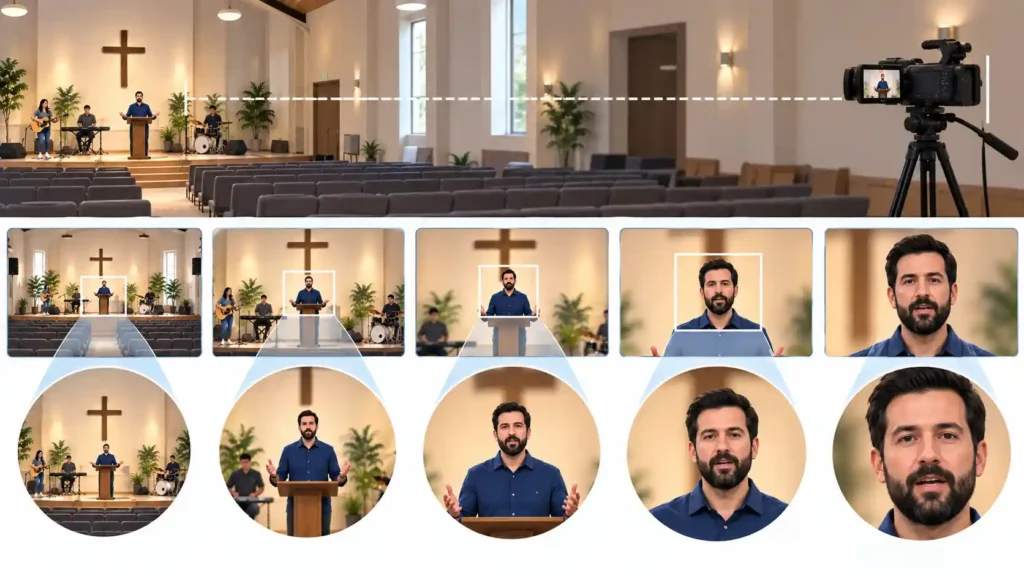
A camera’s sales listing often shows a large, tempting number: “20x zoom” or “30x optical zoom.” It looks like an easy way to judge whether the camera will be enough to film a speaker from 20 metres away. In reality, this number doesn’t tell you nearly enough — two cameras that both list “20x zoom” can reach entirely different distances in practice. To judge a camera correctly, you need to understand three different figures that sales material tends to use interchangeably: zoom ratio, focal length in millimetres, and 35mm-equivalent focal length.
What the zoom ratio actually tells you
The zoom ratio is the lens’s own internal range expressed as a ratio: how many times longer the longest focal length is than the widest one. “20x” only means the lens’s longest setting is 20 times its widest setting — it says nothing about which starting point that’s measured from.
Consider two cameras, both listed with “20x zoom.” One lens starts from a very wide angle and ends at a moderate telephoto. The other starts from an already narrower angle and ends up considerably longer. Both are sold with the same “20x” figure, but only one of them reaches close enough to the speaker in a 20-metre room. The zoom ratio tells you the lens’s own relative range, not its actual reach.
Focal length: what it is and why it decides the outcome
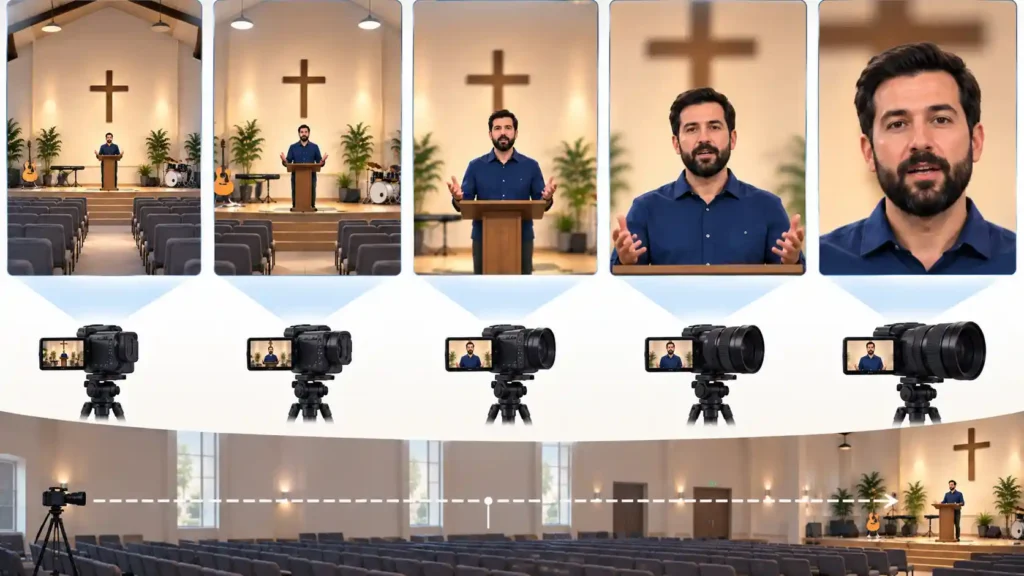
Focal length is a physical property of the lens that determines how large or small a subject appears in the frame from a given distance. A short focal length produces a wide, open shot. A long focal length produces a narrow, strongly zoomed-in shot. This is the figure that should drive the purchase decision — not the zoom ratio.
But a millimetre figure alone isn’t enough, because the same focal length looks different on different cameras. The reason is sensor size. A smaller image sensor “crops” a wider picture down more tightly, so the same physical focal length produces a noticeably tighter, closer-looking shot on a smaller sensor than on a larger one. Because of this, one camera can achieve a long reach with a small, cheap lens, while another would need a large, expensive lens for the same result.
To make this comparison possible, a single common unit is used: 35mm-equivalent focal length. It states what focal length an old 35mm film camera would have needed to produce the same angle of view. Once two different cameras are converted to the same scale, they can be compared honestly regardless of sensor size. On a camera’s spec sheet, this may also be labeled with the term “35mm equivalent” — it means the same thing. The 35mm-equivalent focal length is exactly the figure that tells you whether a camera will reach far enough for your room.
What happens when a camera doesn't reach close enough
In a 20-metre church auditorium, the difference shows up quickly. If the 35mm-equivalent focal length is too short, the speaker appears as a small figure in the middle of the stage — expressions disappear, eye contact is lost, and a viewer at home has to guess the emotional tone instead of seeing it. The picture can be technically perfectly sharp and still fail to serve the viewer, because the essential thing — the face — isn’t visible.
The basic relationship is simple: doubling the shooting distance requires roughly doubling the focal length to keep the same framing. But framing itself depends on the camera’s actual field of view at that focal length, not just a rule of thumb. Cameras record 16:9 video, so the examples below use 16:9 field-of-view calculations — distance + focal length + angle of view → actual coverage — rather than a 3:2 still-photo frame, which would give a taller, narrower result and mislead the comparison.
Unless otherwise noted, all framing examples on this page assume a 16:9 video image.
The table below shows four common framing sizes and the approximate 35mm-equivalent focal length needed to reach them at typical church-auditorium distances. Each size corresponds to roughly how much vertical height the 16:9 frame needs to cover for an average adult, including some headroom:
- Full body — roughly 2 m of vertical frame height
- Waist-up (medium shot) — roughly 1.0–1.2 m
- Chest-up — roughly 0.7–0.8 m
- Head-and-shoulders (close-up) — roughly 0.4–0.5 m
These are approximate: a taller or shorter subject, tighter or looser headroom, and camera height all shift the real number somewhat. Treat every figure below as a starting point for comparison, not an exact spec.
| Shot size (16:9 frame) | 10 m | 15 m | 20 m | 25 m |
|---|---|---|---|---|
| Full body (head to feet, with headroom) | ~90–110 mm | ~140–160 mm | ~180–220 mm | ~230–270 mm |
| Waist-up (medium shot) — the size most purchase decisions are sized against | ~180–200 mm | ~270–300 mm | ~350–400 mm | ~450–500 mm |
| Chest-up — a tighter shot; useful reserve rather than a bare minimum | ~260–300 mm | ~390–450 mm | ~520–600 mm | ~650–750 mm |
| Head-and-shoulders (close-up) — demanding; a stretch target on an ordinary budget | ~420–500 mm | ~650–750 mm | ~850–1000 mm | ~1050–1250 mm |
The waist-up row is the one most purchase decisions are sized against, and it’s less demanding than it might seem: from 20 metres, roughly 350–400 mm of 35mm-equivalent focal length is already enough for a usable medium shot. As a real-world example, the Canon CR-N500 reaches 382.5 mm (35mm-equivalent) at its telephoto end, and Canon specifies its angle of view there as approximately 5.7° horizontal × 3.2° vertical — which works out to roughly 1.1 metres of vertical coverage at 20 metres, right in the waist-up range (see the Canon CR-N500 specifications).
A camera reaching further than this — say, 500–600 mm equivalent — isn’t required for a basic waist-up shot, but it buys real operational margin: room to go tighter (chest-up), to crop in slightly during editing, or to cover a speaker who ends up further from the camera than expected. The Panasonic HC-X2000, for example, reaches roughly 600 mm (35mm-equivalent) at full optical zoom — worth treating as useful telephoto reserve, not as a minimum requirement for an ordinary medium shot (see the Panasonic HC-X2000 specifications).
This also shows directly why an ordinary phone or a fixed webcam isn’t suitable as a main camera in a 20-metre auditorium: their 35mm-equivalent focal length is usually only a few millimetres, at most in the low tens — nowhere near even the full-body row of the table above, let alone a usable waist-up shot. Filmed with such a camera, the speaker would still be reduced to a small figure in the middle of the frame from 20 metres away, even if the picture itself were sharp.
The bottom row of the table is there deliberately, because it teaches an equally important lesson in the other direction: a genuine head-and-shoulders close-up, with the face filling the frame, still needs roughly 850–1000 mm from 20 metres — less extreme than older rules of thumb suggested, but still a serious telephoto reach that many affordable PTZ and camcorder-style cameras don’t reach on their own. This is why most purchase decisions are sized against the waist-up shot, not the close-up: it’s the framing that brings the speaker close enough while still remaining realistically achievable. Chest-up is usually the tightest realistic target on an ordinary budget; true head-and-shoulders framing is worth planning for only if the camera’s telephoto reach genuinely supports it, or if the camera can be positioned closer.
Why digital zoom or after-the-fact cropping isn't enough
If the optical reach falls short, the temptation is to patch it with digital zoom or by cropping the picture tighter afterward. In most cases this doesn’t solve the problem: once a picture is already shot at the same resolution as the final stream, digital zoom and after-the-fact cropping add no extra detail — they simply enlarge the area already captured, softening the picture and increasing graininess. There’s a narrow exception: if the camera shoots at a resolution clearly higher than the final stream, a moderate centre crop can preserve enough detail — but only up to a point, beyond which the same problem returns exactly as before. Even so, don’t rely on this in a purchase decision: at best it’s a small margin on top of optics that are already sufficient, not a substitute for them. The purchase decision needs to rest on sufficient optical reach — so the result doesn’t depend on whether your camera happens to shoot at a higher resolution than you need.
A practical test for your own space
What your own auditorium requires is simple to find out: measure the actual distance from the camera position to the speaker’s usual spot, decide which framing you actually want (waist-up is the usual default), and check the camera’s spec sheet for its 35mm-equivalent focal length and, ideally, its stated angle of view — not just the zoom ratio. If the distance is closer to 10 or 25 metres than to 20, the table’s other columns point the way. It’s worth aiming for a camera that comfortably exceeds the table’s figure for your target framing, not one that hits it exactly — that leaves margin for a subject who stands slightly further back than expected, and room to crop in a little during editing.
Treat every number on this page as an approximation. Actual framing shifts with the subject’s height, the camera’s exact position and height, stabilization crop (many cameras crop the sensor further when image stabilization is active), the specific recording mode in use, how the sensor is read out in that mode, and how the manufacturer chose to calculate its “35mm-equivalent” figure in the first place — some base it on the diagonal angle of view, others on a particular crop or recording mode. When it matters, verify with the manufacturer’s own stated angle of view for the exact mode you’ll record in, and check your numbers with a tool such as the Frameboard field-of-view calculator.
Sources: Canon CR-N500 specifications · Panasonic HC-X2000 specifications · Frameboard field-of-view calculator
What to Remember
- The zoom ratio (“20x”) tells you the lens’s own relative range, not its actual reach — it isn’t enough on its own to base a purchase decision on.
- The figure that decides is the 35mm-equivalent focal length together with the camera’s actual angle of view, because together they make cameras with different sensor sizes comparable.
- Unless otherwise noted, framing examples on this page assume a 16:9 video image, not a 3:2 still-photo frame.
- From 20 metres, roughly 350–400 mm (35mm-equivalent) already gives a usable waist-up shot; 500–600 mm and beyond is useful telephoto reserve, not a bare minimum.
- Doubling the distance roughly doubles the focal length needed for the same framing — the same relationship applies to every shot size.
- Digital zoom or a tight after-the-fact crop doesn’t replace sufficient optical reach.
- Real numbers vary with subject height, camera position, stabilization crop, recording mode, and how a manufacturer defines its 35mm-equivalent figure — check the camera’s own stated angle of view when precision matters.